

Logic-defying Adventures, part ii
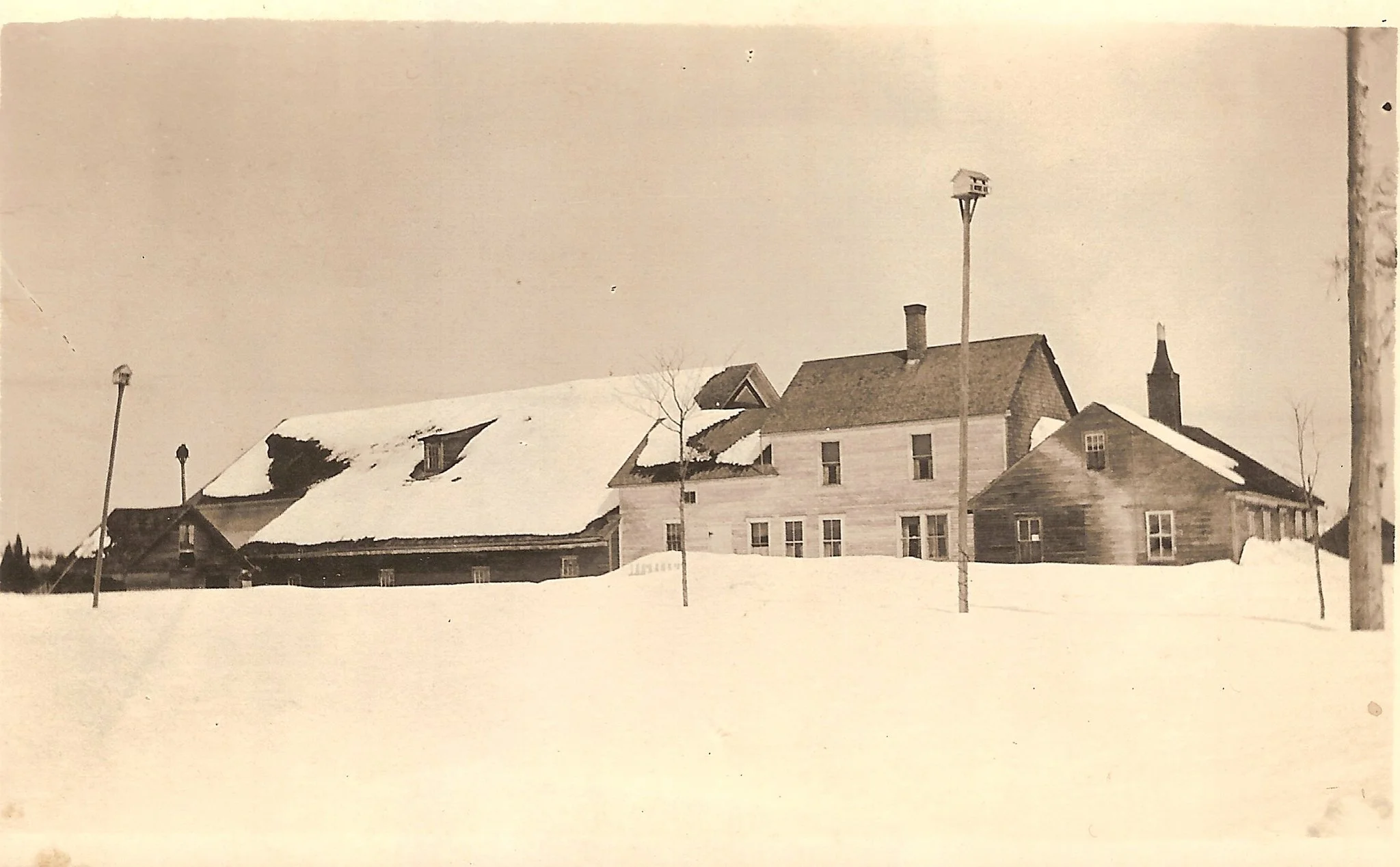
The farmhouse I grew up in. I’m not sure what year this was taken but when I was a small child, the baby maple in the center was already a large, mature tree.
Here are two more stories of mysterious, unexplainable happenings from my childhood.
My little brother is only a year younger than me and we used to play outside unsupervised starting at a tender age, which was normal back then. We grew up in a farmhouse built by our ancestors on a river basin in central Maine. A bubbling brook ran past our home and emptied into the Piscataquis River a couple fields away.
We spent most of our playtime on the banks of the brook, even in the winter when we were strictly prohibited by our mother from going down there. We were usually obedient children so what lead us to break this rule?
It was the call of the ice people. A little section of the brook ran slightly downhill and in the winter the ice formed delicate shelves and grottos from which you could hear the water running and dripping underneath, echoing eerily. For six-year-old me, the combination of these visual and acoustic delights was irresistible. I remember telling my brother that the ice people had their homes in the grottos and the enchanting sound was their singing.
This particular winter day was sunny. We bundled up in our snow suits, grabbed our sleds and trudged across the street to the sledding hill. Just a short way from the bottom of the sledding hill was the part of the brook where the ice people lived, and that’s where we ended up.
The brook was usually quite shallow (which is why at other times of the year we were allowed to play there) but that day the water was deeper and more exciting than usual.
I told my brother that if we were very careful to stay on the bank, we’d be safe. Initially entranced by the ice people, we were soon distracted by the blipping, blopping bubbles of air moving beneath the surface of the clear ice. Delighted, we followed their journey downstream and forgot about the danger.
My brother slipped and fell into the brook at an open spot and was pulled by the current under the surface of the ice. I remember that clearly. The next thing that I remember, we were trudging back up the sledding hill toward home. My memory between those two events is completely blank.
My brother says that I pulled him out when he surfaced at the next opening in the ice downstream. I have no memory of this. I had forgotten about this incident for many years (decades?) until he recalled it one day at a family dinner. When he got to the part about me pulling him out, the first thought that popped into my mind was, “The stream didn’t want him.”
Again, I have no memory of pulling him out and when you consider the logistics, how could I have managed that? Imagine how heavy his soaked snow suit and boots would have made him for the likes of little me. And then how did I make it so quickly from one opening to the next in time to catch him, in the first place?
Imagine the water he would have inhaled in his underwater interval, the shock of the frigid water to his little body… And yet, we walked back up the hill and through our front door like nothing. We didn’t tell our mother about this brush with death until years later.
What exactly happened there? God knows, but “the stream didn’t want him” feels right to me.
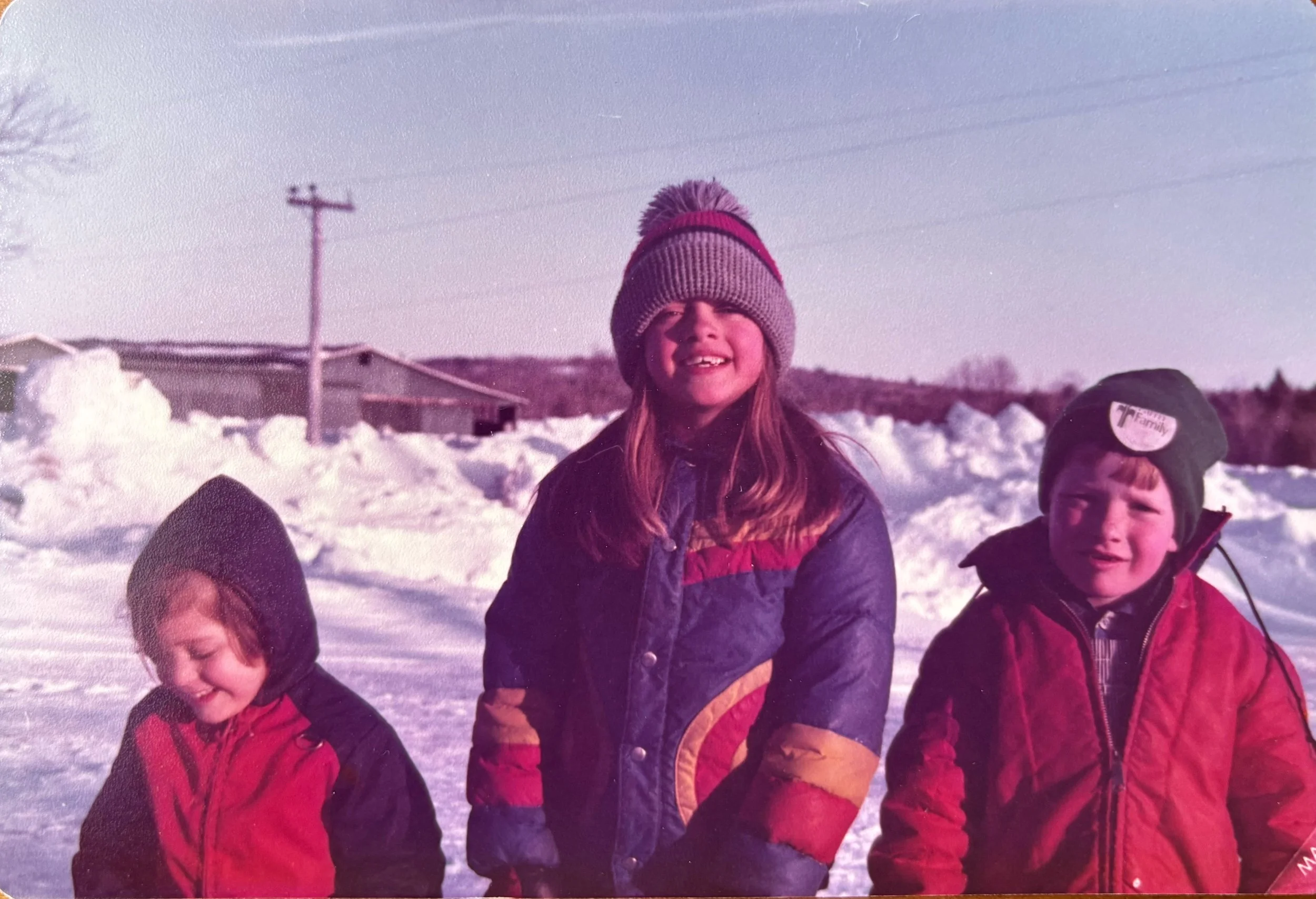
The following winter. Here we were 3, 7, and 6.
A couple years later my dad bought me a horse. She turned out to be a nasty piece of work but we didn’t know that at the time. She seemed very gentle when we met her, but she was probably drugged, poor thing. One day I was grooming her and just when I started untangling her tail, she kicked me in the face. I flew across the stall and fell to the ground, sprawled out on the shavings.
I slowly rose to my feet, not feeling much pain. I noticed there was blood on my face and that scared me. I started crying as I rode my bicycle home, but not from pain or fear. My heart was broken at the horse’s betrayal, and that’s why I don’t mention her name. My brother still remembers the horrible shock of seeing me come up the driveway on my bicycle sobbing, blood streaming down my face, the front of my t-shirt dark with blood.
My father took me straight to the emergency room. It turned out all that blood came from one little cut high on my cheekbone, less than an inch from my temple. I didn’t even need stitches. I didn’t appear to have a concussion, but they told my father to not let me sleep for a few hours and to keep an eye on me. I had no other injuries. We stopped at a corner store on the way home to pick up a pizza.
A couple days later my father took me down to the horse’s stall and asked me to show him exactly what happened—where I was standing when she kicked me, which direction I was facing, and where I landed. He asked me to repeat the story multiple times. I remember him pacing around the stall and shaking his head slightly, I assumed out of anger at the horse.
It was many years later, after my father had passed, that my brother told me that my father never believed the horse kicked me in the head. He told my brother there was no possible way that I would get away without more severe injury if it had really happened as I said.
Also, there was no way the horse could have kicked me to that end of the stall. It was L-shaped, and I would have had to follow an air-born L-shaped route from where I said I was standing to where I said I landed. He told my brother I must have been bumped or pushed by the horse and then hit my head on the edge of a stall board.
My father didn’t think I lied about it. He assumed I must have experienced some memory loss.
I was never at any time confused about my perception of what happened. For me it was clear as day. One second I was brushing the horse’s tail and the next, pulling myself up from the floor at the other end of the stall.
Once I considered it from an adult perspective, I saw that it could not have logically happened the way I remember. I was standing inches away from the right hind leg of that horse. If she had kicked me in the face from that distance, I would be severely injured or dead.
Only God knows what happened. And maybe the horse.
